
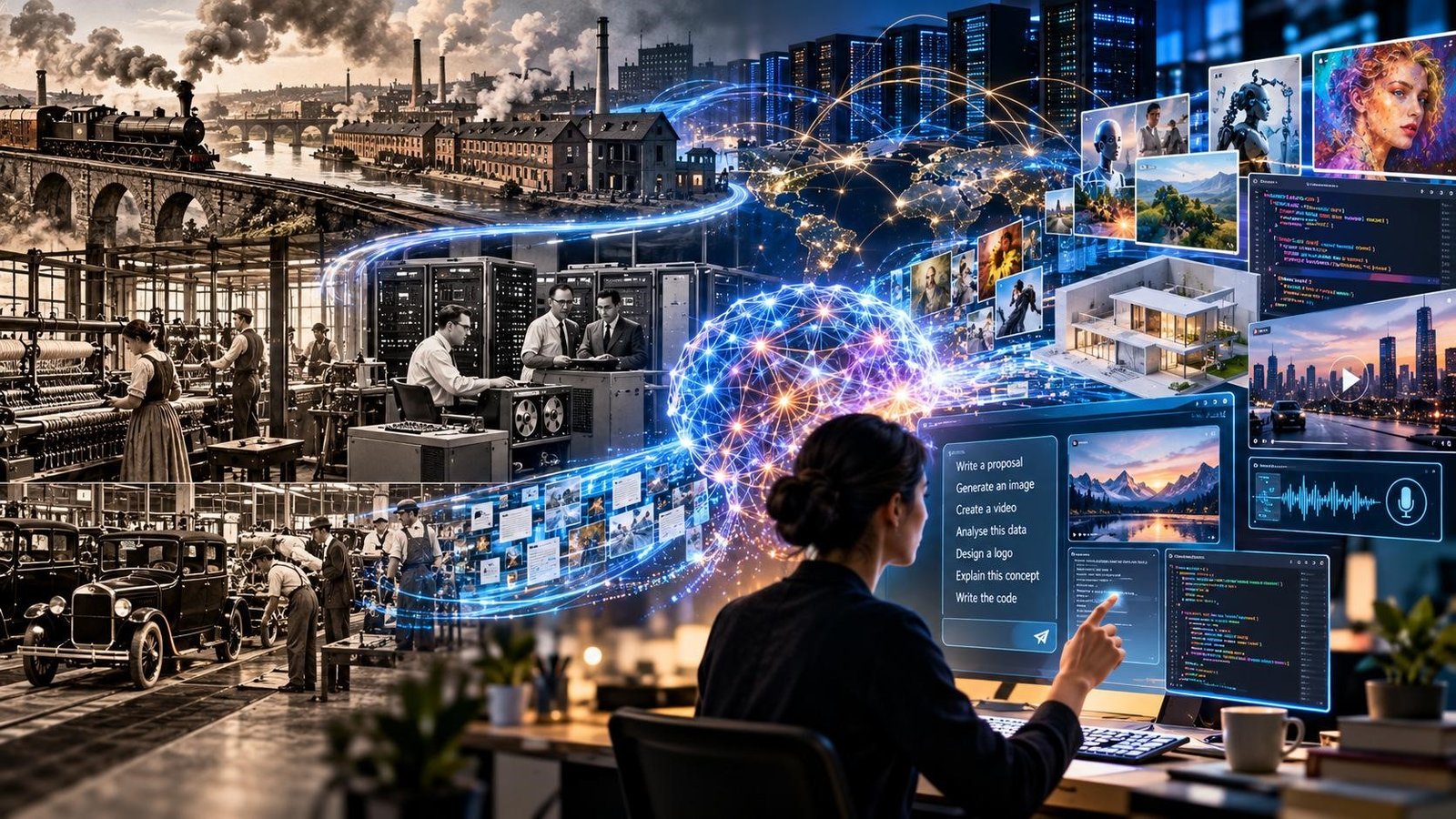
For much of the industrial age, the division between human beings and their machines was relatively clear. People conceived ideas, made decisions and directed work, while machines supplied the power and precision needed to carry it out. A factory could produce thousands of identical products, but someone had to design them. A computer could process a document almost instantly, but someone still had to write it.
That relationship is beginning to change.
Today, a person can describe an image and receive an illustration that did not previously exist. A programmer can explain what an application should accomplish and receive a working starting point. A writer can provide a subject and ask a computer to develop an article, while a researcher can submit documents for analysis and receive a structured account of their contents.
The results are not always reliable. A convincing answer may contain mistakes, and the ease with which these systems produce material can conceal serious weaknesses. Nevertheless, their capabilities represent a significant development in the long history of machinery. Computers are increasingly participating in the production of work that previously depended heavily upon human intellectual effort.
This is the development that has brought generative artificial intelligence into the centre of the Fourth Industrial Revolution.
It did not appear suddenly, nor did its history begin with the release of ChatGPT in 2022. The technology rests upon more than two centuries of industrial development, decades of computer science and the extraordinary growth of digital information.
To appreciate its significance, we must consider what the earlier revolutions achieved and the limits they left behind.
Each Revolution Changed What Machines Could Do
The First Industrial Revolution transformed production by making mechanical power available on a scale that human and animal labour could not match. Steam engines drove machinery, pumped water from mines and eventually powered locomotives, loosening some of the physical constraints that had governed economic activity for centuries.
The Second Industrial Revolution extended those gains through electricity, steel, petroleum and mass production. Factories became more flexible, transport systems expanded and manufacturers learned to produce complicated goods in enormous quantities. Henry Ford’s assembly lines demonstrated how machinery, standardised components and carefully organised labour could make products affordable to a far wider market.
These revolutions transformed the production of physical goods, but the Third Industrial Revolution approached a different problem.
By the middle of the twentieth century, governments, scientists and businesses were generating more information than people could reasonably process by hand. Electronic computers offered a solution, and advances in semiconductors, integrated circuits and microprocessors gradually made computing more powerful, affordable and accessible.
The computer differed from earlier industrial machines because its purpose could be changed through software. A mechanical loom remained a loom, but a computer could become an accounting system, a word processor or an engineering tool depending upon the instructions it received.
Digitisation transformed the economics of information. Documents, photographs, music and business records could be represented electronically, making them easier to store, modify and reproduce. The internet then connected computers across the world, allowing information to travel almost instantly between individuals, businesses and institutions.
By the beginning of the twenty-first century, humanity had acquired an extraordinary combination of capabilities. Industrial systems could manufacture physical goods at scale, computers could process enormous quantities of information, and global networks could distribute that information at very little additional cost.
Yet much of the intellectual work involved in producing it still had to be performed by people.
A publishing company could distribute an electronic book to millions of readers, but someone had to write the manuscript. An architect could reproduce a digital drawing indefinitely, but the design still had to be developed. Computers could execute sophisticated software, but programmers had to create the instructions.
Generative artificial intelligence began changing this part of the process.
Its significance lies in the distinction between reproducing information and producing it. Earlier digital technologies had made copying and distribution extraordinarily efficient. Generative AI made it increasingly possible to automate portions of the work required to create new material in the first place.
Computers had generated text, music and images in limited forms for decades, but the sophistication and accessibility of modern systems brought those capabilities into ordinary economic life.
The transition would not have been possible without the technologies established during the earlier industrial revolutions. Advanced chips, electrical infrastructure, data centres and global communications networks all support the AI systems now accessible through an ordinary computer or smartphone.
The Fourth Industrial Revolution has been built upon the first three.
Generative AI Emerged From Decades of Research
The previous stage in this technological progression was machine learning, which allowed computers to discover useful patterns from data rather than relying entirely upon rules written by programmers.
Its applications were already widespread long before artificial intelligence became a subject of daily conversation. Banks used learning systems to identify suspicious transactions, email providers filtered unwanted messages, search engines ranked information, and digital platforms recommended products based on patterns in user behaviour.
Researchers had also been exploring whether machines could use learned patterns to generate new examples rather than simply recognise or classify existing ones.
One important development came in 2014 when Ian Goodfellow and his colleagues introduced generative adversarial networks. These systems used two neural networks trained in competition, with one generating artificial examples while the other attempted to distinguish them from genuine data. Through repeated training, the generating network could improve its outputs.
Other approaches followed, including diffusion models that became particularly influential in image generation. Such systems could learn to produce convincing images through a process that gradually transformed random noise into structured visual information.
Language presented a different challenge. Words acquire meaning through their relationships with one another, and understanding a passage often requires recognising connections between ideas separated by several sentences or paragraphs.
A major advance came in 2017 when Google researchers published Attention Is All You Need, introducing the transformer architecture.
Transformers provided a more effective way for neural networks to process relationships within sequences of information. Just as importantly, their architecture made large-scale training practical on increasingly powerful computing hardware.
The timing mattered.
The internet had already produced vast collections of digital text, while semiconductor advances and specialised processors made it possible to train increasingly complex neural networks. Researchers could now combine powerful algorithms with quantities of data and computation that earlier generations had scarcely imagined.
Large language models emerged from this convergence.
During training, these systems learned statistical relationships within enormous collections of text, adjusting their internal parameters as they became better at predicting portions of language from the surrounding context. As their capabilities improved, they could generate coherent passages, translate languages, summarise documents and respond to increasingly varied instructions.
OpenAI’s GPT-3, introduced in 2020, demonstrated how larger models could perform a wide range of language tasks without requiring separate training for every application. Other research organisations were making related advances, and the field was developing rapidly.
Yet much of this work remained distant from ordinary users.
That changed on 30 November 2022 when OpenAI released ChatGPT.
The technology was not entirely new, but the interface made its capabilities accessible to almost anyone who could type a question. Users no longer needed to understand neural networks or programming languages. They could describe what they wanted in ordinary language, examine the response and provide further instructions.
For many people, this was their first direct experience of artificial intelligence as something they could work with rather than a feature operating quietly inside another product.
Language Became a New Way to Direct Machines
The history of technology is also a history of changing how people interact with machines.
Early industrial machinery required operators to manipulate physical controls. Computers introduced programming languages, while graphical interfaces later made software easier to use through windows, menus and icons.
Generative AI has introduced another possibility. Instead of learning every operation required to complete a task, a person can increasingly describe the intended result.
A designer may describe a scene rather than construct every element manually. A programmer may explain what an application should do and receive an initial implementation. Someone working with a lengthy report may request an explanation or comparison without first learning a specialised analytical program.
This does not make technical knowledge unnecessary. A poorly conceived design remains poor however quickly it can be produced, and software generated without adequate understanding may contain defects that are difficult to identify.
What has changed is the relationship between intention and execution.
Much as industrial machinery allowed workers to supervise processes they had previously performed by hand, generative AI allows people to direct systems that carry out portions of intellectual work.
The development extends beyond written language.
Modern systems can generate illustrations, speech, music and video, while multimodal models can work with combinations of text, images and audio. A user can submit a photograph and ask questions about it, provide spoken instructions or request a visual interpretation of an idea.
These capabilities are beginning to soften the traditional boundaries between different forms of software. A word processor was designed for writing, an image editor for visual work and a programming environment for code. Increasingly, AI systems can assist across several of these activities through a common interface.
Specialised applications will remain important, particularly where precision and professional control are essential. Nevertheless, the amount of technical work required to move from an idea to an initial result is decreasing in many settings.
That makes generative AI especially significant for occupations built around producing and interpreting information.
The Economics of Intellectual Work Are Changing
The earlier industrial revolutions transformed employment most visibly in activities involving physical labour. Textile workers encountered mechanised looms, agricultural labourers faced increasingly powerful machinery, and factory workers adapted to assembly lines and industrial robots.
Generative AI brings a similar disruption into offices, classrooms, studios and professional workplaces.
Consider legal drafting. Preparing a legal document may require examining facts, identifying applicable law, developing an argument and expressing it clearly. Generative AI can assist with organising material and producing an initial draft, potentially reducing the time required for parts of the process.
But a well-written document is not necessarily a correct one. Its authorities may be inaccurate, its reasoning may overlook important distinctions, or its conclusions may not follow from the evidence. Professional judgement remains necessary to determine whether the work is reliable.
The same distinction applies elsewhere. Teachers can use AI to prepare learning materials but remain responsible for their suitability. Programmers can produce code more quickly but must still test its behaviour and security. Researchers can obtain assistance with literature reviews without assuming that every generated summary faithfully represents the underlying studies.
The technology can make production easier without guaranteeing quality.
Even so, the productivity implications are substantial.
In a study published in Science in 2023, researchers Shakked Noy and Whitney Zhang examined the use of ChatGPT in professional writing tasks. Participants with access to the technology completed their assignments more quickly and received higher quality assessments on average than those working without it.
The experiment concerned particular writing activities and cannot establish what will happen across every profession. It nevertheless demonstrated that generative AI could improve productivity in work involving language and information.
For organisations, the attraction is clear. Tasks that previously required considerable time may be completed more quickly, allowing employees to concentrate on other responsibilities or enabling businesses to increase output.
For workers, the consequences are less straightforward.
Industrialisation created new occupations while displacing established trades. The digital revolution produced entire industries around software and online services, but it also undermined older business models and reduced demand for certain skills.
Generative AI may produce similarly uneven effects. Some professionals will become more productive, while others may find that activities requiring years of specialised training can increasingly be assisted or performed by software. Organisations may reorganise their operations, and new occupations may emerge around developing, supervising and applying AI systems.
It is too early to determine how these changes will ultimately affect employment across different industries. What is already apparent is that the technology can alter the amount and type of human effort required for particular tasks.
The deeper economic development concerns the cost of intellectual production.
Mass production reduced the cost of manufacturing goods. Digital technology reduced the cost of copying and distributing information. Generative AI is beginning to reduce the cost of creating certain kinds of information in the first place.
This distinction helps explain why its effects may extend well beyond the technology industry.
A company does not have to develop an AI model to benefit from it, just as businesses did not need to manufacture electrical equipment to benefit from electrification. What matters is whether the technology can be incorporated into existing work in a way that improves productivity without sacrificing quality.
The same question confronted businesses during earlier industrial revolutions. Those that successfully reorganised production around new technologies often gained advantages over competitors that continued working as before.
But adopting a technology and making effective use of it are different things. The experience of earlier revolutions suggests that meaningful productivity gains frequently require changes in skills, organisation and working methods.
Generative AI may spread through software faster than earlier industrial machinery could be installed, but its lasting economic effects will depend on how people and institutions adapt.
Machines Are Beginning to Assist Invention
The most consequential applications of generative AI may eventually extend beyond writing documents, producing images or developing ordinary software.
Artificial intelligence is increasingly being used in scientific research and technological development, where computational models can help researchers examine possibilities that would otherwise require substantial time and resources.
In biology, systems such as AlphaFold have demonstrated how machine learning can contribute to the prediction of molecular structures. AlphaFold 3, described in research published in Nature in 2024, extended this work through an architecture incorporating generative diffusion techniques to model interactions involving proteins and other molecular components.
These systems do not replace laboratory experiments, and their predictions still require careful evaluation. Their contribution lies in helping researchers investigate structures and relationships that would be difficult to examine individually.
Related approaches are being explored in materials science, engineering and software development.
There is an important historical connection here.
The steam engine helped manufacture machines that made further industrial expansion possible. Electricity supported increasingly sophisticated production, while computers became indispensable to engineering and scientific calculation.
Each revolution therefore helped create the conditions for further invention.
Artificial intelligence continues that pattern, but its contribution is becoming more direct. Computers can now assist not only with the calculations involved in a design but also with proposing possible designs. Software can help develop other software, while generative models can suggest structures, combinations and approaches that researchers may consider worth investigating.
Technology is becoming a more active instrument in the development of new technology.
This does not mean machines are independently conducting every stage of scientific discovery. Research still depends on experiments, reliable evidence, conceptual insight and the ability to distinguish useful findings from misleading ones.
Yet improvements in the speed at which possibilities can be explored could have far-reaching consequences. If researchers can investigate more potential solutions, test ideas more efficiently and reduce time spent on certain technical tasks, the pace of innovation itself may change.
That possibility gives the Fourth Industrial Revolution a distinctive character.
It also makes the limitations of generative AI particularly important.
These systems can produce convincing explanations that contain factual errors, invent references or present conclusions unsupported by evidence. The problem arises partly because generating plausible language is not the same as verifying facts against independent sources.
More sophisticated systems can consult documents, search for information and use external tools to improve reliability, but those capabilities do not make every response correct.
The risks become especially serious in medicine, law, engineering and scientific research, where an apparently minor error can have significant consequences.
Generative AI also raises questions about copyright, privacy, misinformation and accountability. The ability to produce realistic images, voices and videos creates opportunities for legitimate creative work alongside new possibilities for deception.
Nor has artificial intelligence escaped the physical requirements of earlier technology. Its apparent simplicity conceals an industrial system built around advanced semiconductors, data centres, electricity, cooling infrastructure and global communications networks.
The Fourth Industrial Revolution remains dependent upon the achievements of the first three.
This dependence has economic consequences. Organisations and countries that control advanced computing infrastructure, research capacity and access to energy may occupy stronger positions in the developing AI economy.
For African countries, the challenge extends beyond adopting systems created elsewhere. It includes building the expertise, infrastructure and institutions needed to adapt and develop technologies suited to local needs.
The history of industrialisation offers little reason to assume that the benefits of technological progress will be distributed equally. The ownership of machinery, access to capital and ability to apply new technologies have always shaped who gains most from industrial change.
Generative AI will be no exception.
That brings us back to the question that has followed this series from the beginning.
What makes the Fourth Industrial Revolution different?
It is not simply that machines have become faster or more capable. Every industrial revolution has achieved that in its own way.
The difference lies in the kinds of work machines can now perform.
Steam expanded human physical power, electricity transformed industrial production, and computers changed how information could be processed and distributed. Machine learning allowed computers to discover patterns within that information, while generative AI now enables them to use those patterns to produce new material across an expanding range of intellectual activities.
The result is a technology increasingly capable of participating in work that begins with human knowledge, judgement and creativity.
That participation remains imperfect, but it is already changing how people write, design, programme, research and communicate.
For more than two centuries, technological progress has steadily reduced the human effort required to perform particular tasks. Generative AI extends that history into activities once considered largely beyond the reach of machinery.
The important question is therefore no longer simply how much more work machines can perform.
It is how human work itself will change as machines become increasingly capable of contributing to the ideas, designs and decisions from which that work begins.
Next in The Trend Report
Artificial Intelligence Is Changing Human Work
Cognitive Automation Is Reaching the Professional World
Resources
The principal references for this article include the 2017 transformer research Attention Is All You Need; Ian Goodfellow and colleagues’ 2014 work on generative adversarial networks; OpenAI’s publications on GPT-3 and ChatGPT; Noy and Zhang’s 2023 research on generative AI productivity published in Science; the 2024 Nature publication on AlphaFold 3; and the International Energy Agency’s research on electricity demand from data centres.









One Response
“These systems can produce convincing explanations that contain factual errors, invent references or present conclusions unsupported by evidence. The problem arises partly because generating plausible language is not the same as verifying facts against independent sources.
More sophisticated systems can consult documents, search for information and use external tools to improve reliability, but those capabilities do not make every response correct.
The risks become especially serious in medicine, law, engineering and scientific research, where an apparently minor error can have significant consequences.”….
True. Over reliance on Gen AI is not a good habit, it has a knack for making well-phrased or sugar-coated errors. You have to have prior knowledge of what you want so that you can figure it out when the machine is misguiding you….
Thanks counsel