
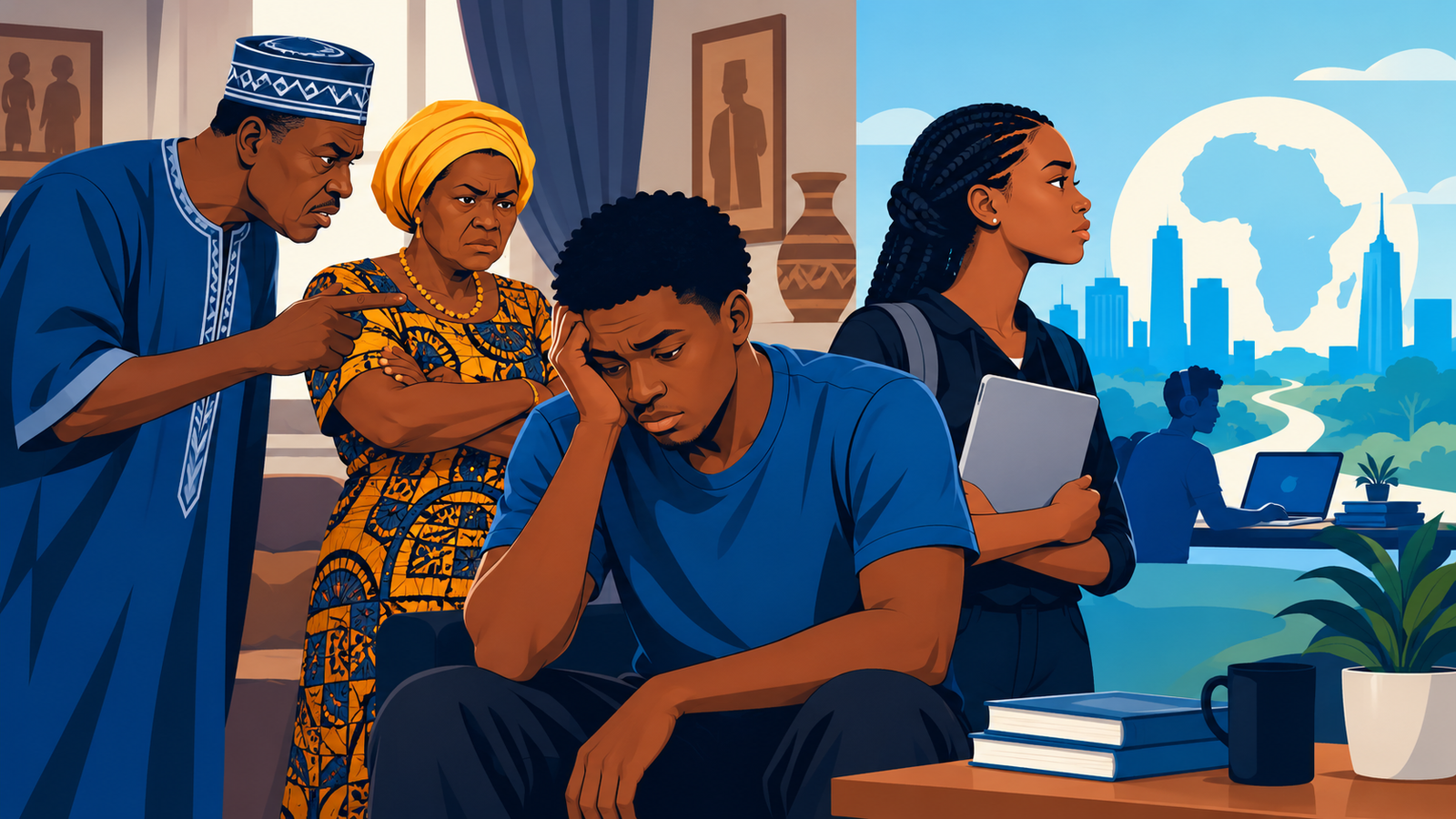
Toxic parents are not a Western invention. They exist in every culture. But across much of Africa, a distinctive form flourishes under the protective cover of “culture,” “respect,” and “tradition.” Many older parents—shaped by pre-independence scarcity, limited access to schools that left deep pockets of ignorance, the residual authoritarianism of colonial rule, rigid extended-family hierarchies, and religious values rooted in traditional African worship and ancestor veneration—still raise children as if the calendar froze in 1975. The result is not wisdom. It is damage.
Under constant criticism, emotional withholding, and physical punishment framed as “discipline,” these parents demand absolute obedience while accepting almost no accountability themselves. A child who questions a decision is met with the familiar retort: “I am your parent, not your friend.” The statement is technically true—parents are not peers—but it is routinely used to close down any legitimate discussion about money, career paths, choice of spouse, religious belief, or mental health. The same parents who expect lifelong financial support, housing, and caregiving from their adult children often refuse to examine their own patterns of emotional neglect, outdated economic assumptions, or rigid control. In practice, respect travels in only one direction: upward. Any attempt by the younger generation to set boundaries or request reciprocity is treated as disrespect, rebellion, or Western contamination.
Many still treat education as a family status trophy rather than preparation for a competitive global market. They pressure children into law, medicine, or engineering regardless of aptitude, interest, or actual job availability, then shame those who later pivot to technology, creative industries, or entrepreneurship when the “prestigious” path yields underemployment or debt. The romanticization of past hardship—“we walked barefoot to school,” “we had nothing and still made it”—is frequently deployed as moral leverage, as if enduring scarcity automatically confers wisdom or justifies refusing to adapt. It does not. The economic and social landscape has shifted. Smartphones, remote work, digital skills, mental-health literacy, and individual agency are not Western decadence; they are practical tools of survival and mobility. Clinging to outdated scripts leaves many young adults either crushed by intergenerational guilt or permanently alienated from the very families that claimed to invest in their future.
Control over adult children’s lives remains widespread. Marriage is frequently treated as a family transaction rather than a personal bond, with parents asserting veto power over partners, timelines, and even the terms of the union itself. Career decisions that take a child far from home—whether for work, study, or simply independence—are often framed as abandonment or ingratitude. Divergent views on religion, politics, sexuality, or lifestyle are still met in many households with threats of disownment, accusations of spiritual attack, forced “deliverance” sessions, or social exile, rather than any recognition that adults are entitled to different choices. Women who delay marriage, remain childless, or reject traditional domestic roles face relentless questioning and pressure. Men who express vulnerability or emotional struggle are told to “man up” or “be strong.” The household emotional vocabulary rarely expands beyond “stop crying,” “pray harder,” and “respect your elders,” leaving little room for honest conversation about boundaries or change.
This pattern is not universal. Many African parents do adapt, listen, and deliberately break with the methods they themselves endured. Yet the authoritarian model remains common enough to constitute a quiet public problem. The same generation that correctly condemns colonial arrogance and the violence of the past frequently reproduces rigid, fear-based parenting inside its own homes. “It was done to us” is offered as explanation, even justification. In reality it functions as an admission: the cycle was recognized, but not interrupted. The result is continued emotional injury passed downward under the banners of culture, respect, and survival.
The costs are measurable and accumulating. Many young Africans report elevated rates of anxiety, depression, and chronic guilt as they struggle to reconcile deep filial duty with the need for personal autonomy. A portion of the region’s brain drain is driven not only by better salaries abroad but by the quieter desire to escape constant family surveillance, unsolicited control, and the expectation of lifelong emotional and financial servitude.
Relationships often remain superficially intact until a crisis—illness, death, or financial collapse—exposes years of unspoken resentment; by then, genuine repair is rarely possible. Children raised under relentless criticism and conditional affection tend to split into two camps: perpetual people-pleasers who suppress their own needs until they burn out, or rebels who eventually sever contact altogether. Neither outcome strengthens families or the wider society that depends on healthy intergenerational bonds.
Tradition is not sacred simply because it is old. Respect is earned through competence, consistency, and genuine care—not automatically conferred by age or title. Parents who refuse to update their maps while the social and economic terrain has shifted are not preserving culture; they are manufacturing dysfunction and then blaming the next generation for refusing to live inside it. The world will not slow down to accommodate outdated scripts. Young Africans navigating competitive job markets, digital economies, mental-health realities, and wider personal choices should not be expected to shrink themselves to fit an obsolete mold. Culture that cannot evolve eventually becomes a cage.
Adult children owe their parents basic decency, honesty, and, where circumstances allow, practical support in old age. They do not owe lifelong emotional servitude, the erasure of their own boundaries, or the surrender of independent judgment on career, marriage, belief, or mental health. When parents invoke “culture,” “respect,” or “tradition” primarily to shut down accountability and avoid examining the harm they cause, the language becomes a shield rather than a value. Such behavior deserves to be named clearly: it is not cultural preservation. It is toxic parenting.
The rest of us can keep what remains genuinely valuable in African family life—solidarity in hard times, practical intergenerational support, and the resilience forged by shared struggle—while discarding the authoritarian control, emotional suppression, and one-way demands that have too often been smuggled in under the same labels. Culture is not a museum. It is a living practice. The parts that protect and strengthen can be retained. The parts that wound and stunt can be left behind without apology.